
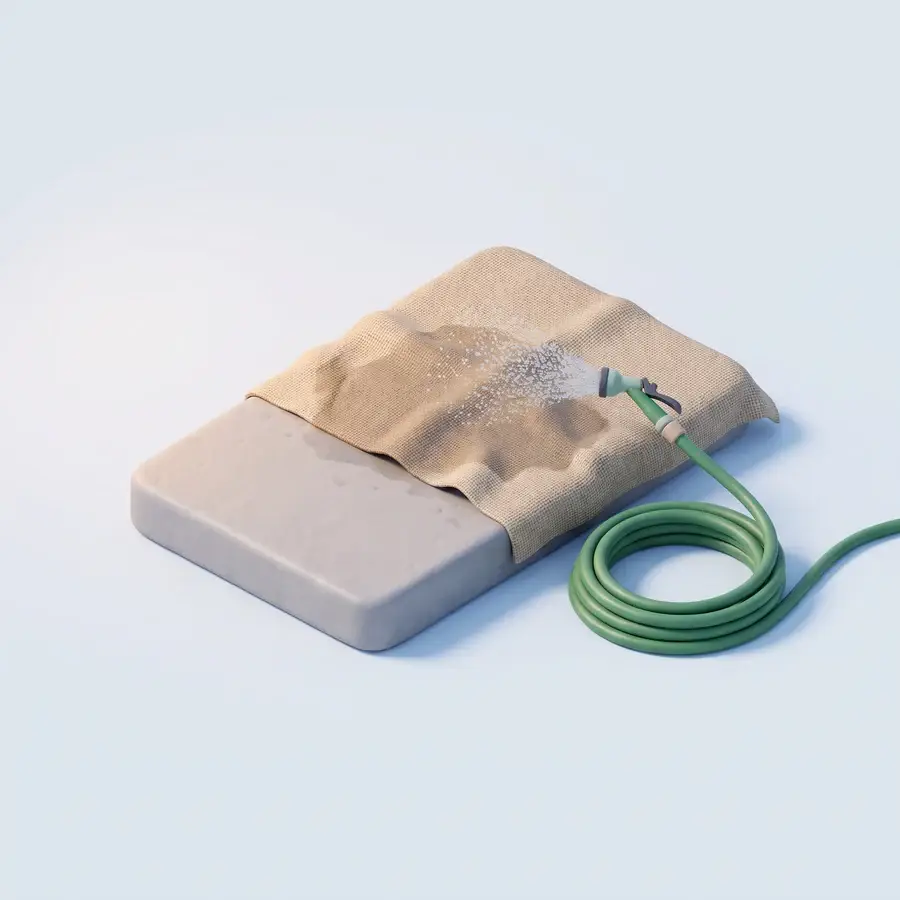
How long concrete takes to dry and cure
Keep new concrete moist for 5 days in warm weather or 7 days at 50 to 70 °F, keep it from freezing for about the first 2 days, and expect about 60% of its strength at 7 days and its full design strength at 28 days. Pick your pour date for a dated schedule you can add to your calendar.
Your curing schedule
- Pour dayPour, finish and start curing
Start curing as soon as the surface can take it: a curing compound, wet burlap, plastic sheeting, or a sprinkler kept running. (QUIKRETE)
- Day 1Fence posts can take strain
QUIKRETE says to wait 24 hours before a post set in Concrete Mix takes any load. (QUIKRETE)
- Day 2Past the freezing risk
Concrete has to reach about 500 psi before it can freeze without damage, about two days after the pour. Keep it covered and above freezing until then. (NRMCA)
- Day 5Moist curing can stop
QUIKRETE: keep curing for 5 days when it is 70 °F or warmer. (QUIKRETE)
- Day 7About 2,500 psi
QUIKRETE Concrete Mix reaches 2,500 psi at 7 days, about 60% of its 28-day strength. (QUIKRETE)
- Day 28Design strength, 4,000 psi
Concrete is specified by its strength at 28 days; it keeps gaining slowly after that. (QUIKRETE)
Below 50 °F, curing takes longer and the concrete must be kept from freezing: plan for insulated blankets or heat, and ask your supplier about a cold-weather mix. NRMCA's cold-weather guidance applies.
Reminders arrive at 9 am on each date. On an iPhone, add this site to your home screen first (Share, then Add to Home Screen), then tap Remind me from there.
Curing, not drying
Concrete hardens because the cement reacts with water, not because it dries out. If the surface dries too soon, that reaction slows and the concrete ends up weaker and more prone to cracks. That is why the job after finishing is to keep it moist and at a moderate temperature. The National Ready Mixed Concrete Association says curing should start as soon as the concrete is placed and finished and continue for a sufficient period, typically 3 to 7 days. QUIKRETE's data sheets give 5 days at 70 °F or warmer and 7 days at 50 to 70 °F.
How strength builds
| Age | QUIKRETE Concrete Mix | QUIKRETE 5000 (high early strength) |
|---|---|---|
| 3 days | – | 2,500 psi |
| 7 days | 2,500 psi | 3,500 psi |
| 28 days | 4,000 psi | 5,000 psi |
Concrete is specified by its strength at 28 days. A standard mix is at about 60% of that after a week, so it is hard well before it reaches full strength. QUIKRETE gives its 5000 mix a walk-on time of 10 to 12 hours. For heavy loads such as vehicles, ask your contractor or supplier when the slab is ready.
Ways to cure
- A liquid curing compound sprayed or rolled on once the surface is hard, which seals the water in.
- Wet burlap, kept wet. New burlap should be washed first so it doesn't stain.
- Plastic sheeting or waterproof paper over the slab. It can leave patchy color on colored concrete.
- A lawn sprinkler or soaker hose, run without breaks.
QUIKRETE lists all four on its Concrete Mix data sheet and warns against curing compounds when rain or temperatures below 50 °F are expected within 24 hours.
Cold and hot weather
Fresh concrete that freezes is damaged. NRMCA says to protect it from freezing until it reaches 500 psi, about two days after placing, and to protect concrete that will see repeated freezing and thawing until it reaches 3,500 psi. QUIKRETE says to protect its mixes from freezing for the first 48 hours, with insulated blankets if temperatures will drop below 32 °F. In hot, dry or windy weather the danger is the opposite: water evaporates too fast, which can cause finishing trouble and shrinkage cracks, so start curing promptly.
Sources
- QUIKRETE Concrete Mix (No. 1101) data sheet, The QUIKRETE Companies, revised October 2022. Bag yields: 40 lb 0.30 cu ft, 50 lb 0.375, 60 lb 0.45, 80 lb 0.60, 90 lb 0.675; about 140 lb per cubic foot; 2,500 psi at 7 days and 4,000 psi at 28 days; cure 5 days at 70 °F or warmer, 7 days at 50 to 70 °F; protect from freezing for the first 48 hours.
- QUIKRETE 5000 High Early Strength Concrete Mix (No. 1007) data sheet, The QUIKRETE Companies, revised November 2022. Bag yields: 50 lb 0.375 cu ft, 60 lb 0.45, 80 lb 0.60; walk on after 10 to 12 hours; 2,500 psi at 3 days, 3,500 at 7, 5,000 at 28.
- CIP 11: Curing In-Place Concrete (Concrete in Practice series), National Ready Mixed Concrete Association, 2017 edition. Curing starts right after finishing and continues for a sufficient period, typically 3 to 7 days.
- CIP 27: Cold Weather Concreting (Concrete in Practice series), National Ready Mixed Concrete Association, current edition. Protect concrete from freezing until it reaches 500 psi, about two days after placing; 3,500 psi before repeated freezing and thawing.