
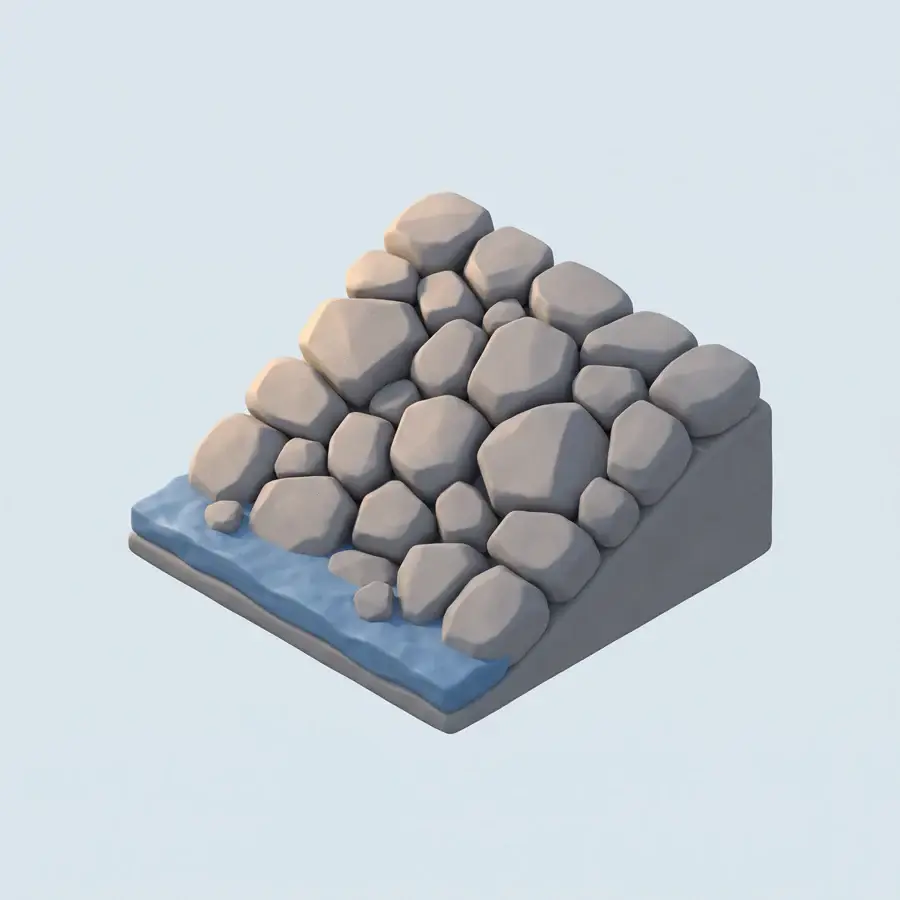
Riprap calculator
An area 20 ft by 8 ft covered in Type L riprap, 9 in median stone, takes a layer 15 in thick and about 13.44 tons, with 10% extra for the uneven surface.
Riprap sizes and thickness
Riprap is sorted by the size of its median stone, the d50: half the rock by weight is smaller than it. The Mile High Flood District, which writes the drainage standards around Denver, specifies five types from VL to VH, and many cities and states use similar classes under other names. Each type also has a largest stone, the size 70 to 100% of the rock is smaller than.
The layer has to be thick enough for the biggest stones to lie fully within it. The Federal Highway Administration's riprap design guide, HEC-11, sets the thickness at no less than the largest stone, no less than 1.5 times the median stone and no less than 12 in, and half as thick again where the riprap is placed underwater. The calculator uses that rule unless you enter the thickness from your drawings.
| Type | Median stone | Largest stone | Layer thickness | Tons per 100 sq ft |
|---|---|---|---|---|
| Type VL | 6 in | 12 in | 12 in | 6.11 |
| Type L | 9 in | 15 in | 15 in | 7.64 |
| Type M | 12 in | 21 in | 21 in | 10.69 |
| Type H | 18 in | 30 in | 30 in | 15.28 |
| Type VH | 24 in | 41 in | 41 in | 20.88 |
What riprap weighs
A cubic yard of riprap in place weighs less than the same yard of solid rock because of the gaps between the stones. Front Range Material, a Colorado supplier, converts riprap at 1.65 tons a cubic yard, and the flood district's specification requires a bulk density of at least 1.3 tons a yard. Dense rock such as granite or basalt weighs more than limestone or sandstone, so ask the quarry for its figure and enter it in the calculator.
Most specifications also put a layer of bedding gravel or filter fabric under the riprap, so that the soil underneath doesn't wash out through the gaps. Nebraska's highway contracts paid $2.35 a square yard for riprap filter fabric in 2025. Work out a gravel bedding layer with the crushed stone calculator.
What riprap costs
State transportation departments publish what they paid for riprap, furnished and placed, on their highway contracts. These are the 2025 averages from five of them. A contractor's price for a small job will usually be higher, and rock from a quarry, without placing, lower.
| State | Item | Average price | Quantity |
|---|---|---|---|
| Nebraska | Rock riprap, Type B | $75.44 a ton | 173,944 tons |
| South Dakota | Class B riprap | $70.54 a ton | 33,479 tons |
| South Dakota | Class C riprap | $83.00 a ton | 5,375 tons |
| Florida | Rubble riprap, ditch lining | $123.96 a ton | 36,376 tons |
| Florida | Rubble riprap, bank and shore | $143.61 a ton | 42,669 tons |
| Wisconsin | Riprap, medium | $112.90 a cu yd | FY 2025 |
| Wisconsin | Riprap, heavy | $67.23 a cu yd | FY 2025 |
| West Virginia | Riprap | $151.96 a cu yd | 918 cu yd |
At 1.65 tons a yard, $100 a ton is $165 a cubic yard. Enter your price per ton or per yard under Prices in the calculator.
When to call an engineer
Riprap that protects a stream bank, a channel or a culvert outlet has to resist the force of the water at its highest, and the right stone size depends on the speed and depth of that flow. A driveway swale or a small slope can use the common sizes above, but anything carrying real flows should be designed by an engineer, and work in a stream usually needs a permit. For smaller decorative stone, see the river rock calculator or the landscape rock calculator; to convert any material between tons and yards, use tons to cubic yards.
Sources
- Specification 31 37 00: riprap, boulders, soil riprap and bedding, Mile High Flood District (Denver), current specification. Riprap types VL, L, M, H and VH: median stone 6, 9, 12, 18 and 24 in, with 70 to 100% smaller than 12, 15, 21, 30 and 41 in; bulk density at least 1.3 tons a cubic yard.
- Design of riprap revetment (HEC-11), U.S. Federal Highway Administration, 1989. Layer thickness at least the larger of the largest stone and 1.5 times the median stone, not under 12 in, and half again thicker underwater.
- Coverage and conversion chart, Front Range Material, current sheet. Crusher fines 1.5 tons a cubic yard loose and 1.8 compacted; riprap 1.65 tons a cubic yard.
- Average unit prices for lettings, 1 January to 31 December 2025, Nebraska Department of Transportation, 2025 lettings. Rock riprap Type B $75.44 a ton over 173,944 tons; broken concrete riprap $51.14 a ton; riprap filter fabric $2.35 a square yard.
- 2025 bid item price report, South Dakota Department of Transportation, 2025 lettings. Average low bid for Class A, B and C riprap: $43.93, $70.54 and $83.00 a ton.
- Historical item average costs, statewide, 2025, Florida Department of Transportation, 2025 lettings. Rubble riprap, furnished and installed: ditch lining $123.96 a ton, bank and shore $143.61 a ton.
- Average unit price list, FY 2023 to FY 2025, Wisconsin Department of Transportation, FY 2025. Riprap light, medium and heavy: $134.48, $112.90 and $67.23 a cubic yard in FY 2025.
- 2025 average unit bid prices, West Virginia Division of Highways, 2025 lettings. Riprap $151.96 a cubic yard, the statewide weighted average of 8 contracts.