
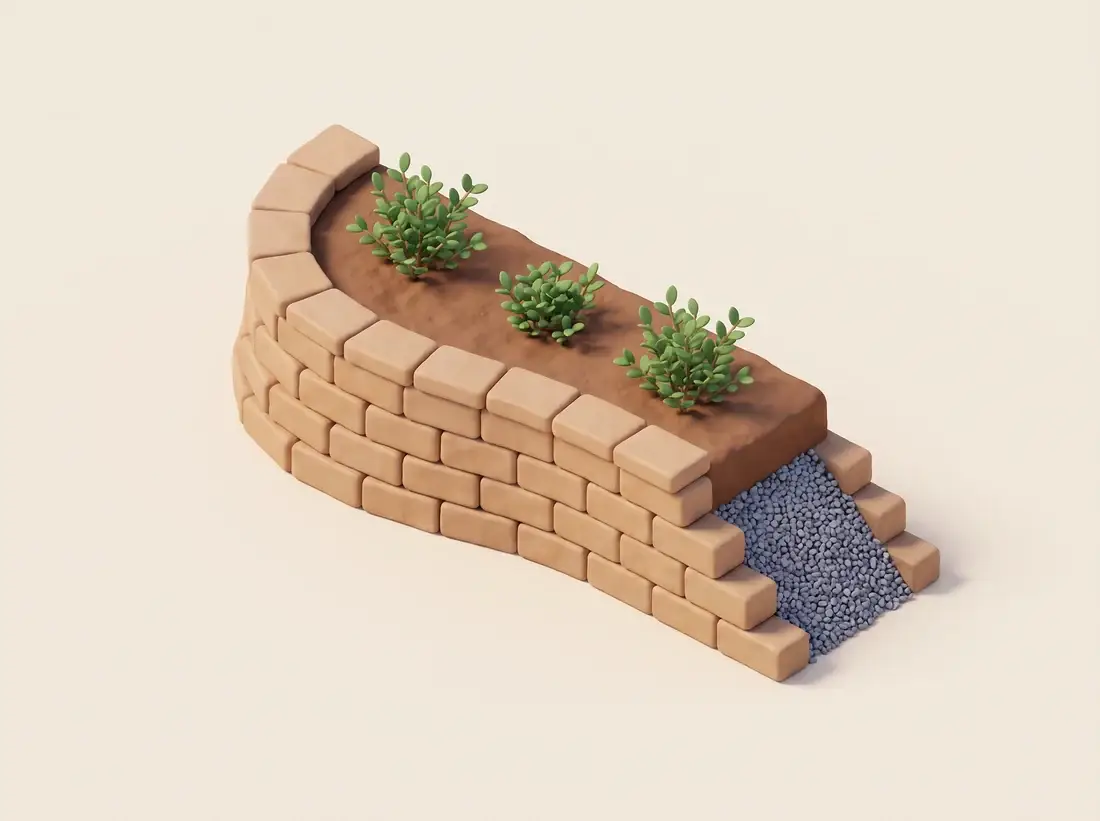
Retaining wall calculator
A wall 30 ft long and 2 ft high in 4 × 12 in blocks, with one course buried, takes 221 blocks and 32 caps with 5% extra, plus about 5.61 tons of base gravel and drainage stone.
How the blocks are counted
Divide the wall's height by the block's height for the courses above ground, add the courses you bury, and multiply by the blocks in one course: the wall's length divided by the block's length. Caps run along the top, one per block length. The calculator adds 5% for cuts, corners and breakage unless you change it.
2 ft ÷ 4 in = 6 courses + 1 buried = 7
30 ft ÷ 12 in = 30 blocks per course × 7 = 210 + 5%
Small segmental wall blocks are commonly sold with a face 4 in high and 12 in long (Pavestone, Belgard, Oldcastle and others list them at that size), so a course is one block per foot. Allan Block's AB Classic is 8 in high, 12 in deep and 18 in long, about 1 sq ft of face, and weighs about 75 lb. Allan Block's sheet says to bury its first course 3 in below grade, set it on a 6 in layer of compacted base rock in a 9 in deep trench, and allow about 60 lb of base rock per linear foot of wall and 105 lb of wall rock per block; the calculator shows those figures too when you choose AB Classic.
Base and drainage
Unilock's installation guide calls for a 6 in compacted gravel base under a wall and 12 in of free-draining backfill behind it. The calculator weighs the base as compacted crusher run at 1.9 tons per cubic yard, and the drainage zone as clean crushed stone at 2,700 lb per loose cubic yard, 12 in thick for the full height of the wall. Your block maker's guide gives the trench width and how deep to bury the first course; use its figures where they differ.
A wall that is tall, holds back a slope, or carries a driveway or a building needs more than a block count. Walls like these usually need an engineered design with geogrid reinforcement, and many towns require a permit, so check with your block maker and your building department first.
Blocks for common walls
| Wall (above ground) | 4 × 12 in blocks | AB Classic (8 × 18 in) |
|---|---|---|
| 10 ft × 1 ft | 42 | 23 |
| 20 ft × 2 ft | 147 | 59 |
| 30 ft × 2 ft | 221 | 84 |
| 30 ft × 3 ft | 315 | 126 |
| 50 ft × 3 ft | 525 | 215 |
| 50 ft × 4 ft | 683 | 250 |
| Item | Typical | Range | Stores |
|---|---|---|---|
| 4 × 12 in face retaining wall block | $3.19 | $2.48 to $3.47 | 10 |
Sources
- Basic Technical Guide: pavers and walls, Unilock, January 2024. Gravel base of 6 to 8 in for patios and walkways, 6 to 12 in for pool decks, 10 to 14 in for driveways; a 1 in bed of coarse sand; 6 in of base under walls.
- AB Classic product sheet, Allan Block (hosted by the Spreckels Memorial District), current sheet. 8 in high, 12 in deep, 18 in long, about 1 sq ft of face and 75 lb a block; bury the first course 3 in; a 6 in base of rock in a 9 in deep trench; about 60 lb of base rock per linear foot and 105 lb of wall rock per block.
- Online store listings for bagged concrete, mortar, grout, block, rebar, mesh, gravel, sand, soil, mulch and pavers, Google Shopping results (Home Depot, Lowe's, Menards, Ace Hardware, Walmart and others), November 2026. Single-item prices by store; the calculators use the median as the default and show the range.
- Weight-Volume Relationships and Conversion Factors for Soils and Aggregates of Wisconsin (WHRP 0092-22-05), Wisconsin Highway Research Program, Michigan State University, December 2023. Measured loose and compacted weights of base aggregates, recycled asphalt and recycled concrete; tons per compacted cubic yard.
- Maintenance Manual Volume 1, Appendix: Useful Information, California Department of Transportation, July 2014. Loose weights of crushed gravel, limestone, granite, screenings, sand and soil; 111 lb of asphalt mix per square yard per inch; 2.0 tons per compacted cubic yard of base.