
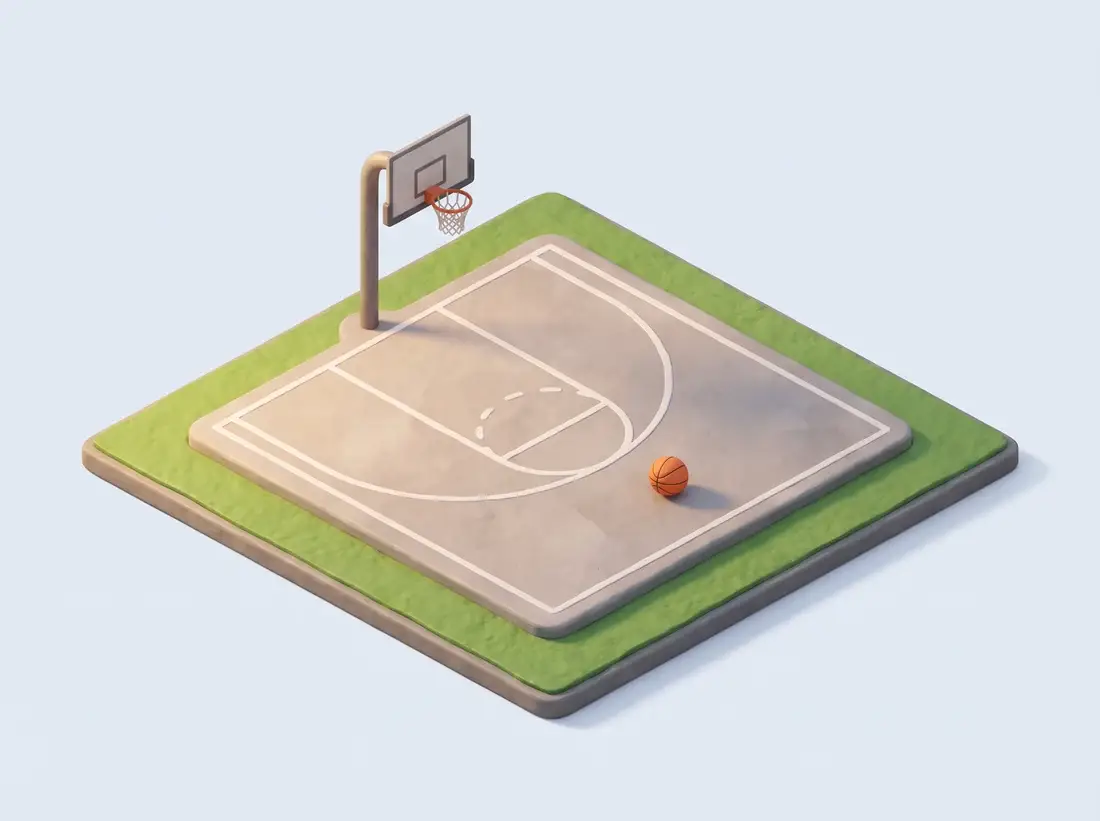
Basketball court dimensions
An NBA or college court is 94 × 50 ft, a high school court 84 × 50 ft, and a FIBA court 28 × 15 m (91 ft 10⅜ in × 49 ft 2½ in). A half court is 47 × 50 ft, or 42 × 50 ft at high school size. The rim is 10 ft high in all four.
Court size by level
Each figure below is from that level's own rules: the NBA's 2025-26 rule book, the NCAA's 2025-26 rules for men and women, the National Federation of State High School Associations (NFHS) court as high school referees are taught it, and FIBA's 2024 rules for international play. Lengths are inside the boundary lines; three-point distances run from the center of the basket to the outside edge of the line.
| Level | Court | Half court | Lane width | Free-throw line | Three-point line | Restricted arc |
|---|---|---|---|---|---|---|
| NBA | 94 ft × 50 ft | 47 ft × 50 ft | 16 ft | 15 ft from the backboard | 23 ft 9 in; 22 ft in the corners | 4 ft radius |
| NCAA, men and women | 94 ft × 50 ft | 47 ft × 50 ft | 12 ft | 15 ft from the backboard | 22 ft 1¾ in; 21 ft 7⅞ in in the corners | 4 ft radius |
| High school (NFHS) | 84 ft × 50 ft | 42 ft × 50 ft | 12 ft | 15 ft from the backboard | 19 ft 9 in all round | none |
| FIBA (international) | 28 m × 15 m | 14 m × 15 m | 4.9 m | 4.6 m from the backboard | 6.75 m; 6.6 m in the corners | 1.3 m radius |
In all four the free-throw line is 15 ft from the face of the backboard (FIBA: 5.80 m from the baseline), and the backboard sits 4 ft in from the baseline (FIBA: 1.20 m), which puts the center of the basket 5 ft 3 in from the baseline. The center circle is 6 ft in radius (FIBA: 1.80 m). The NCAA marks the restricted arc for men's games only; high school courts have none.
Half courts drawn to scale
The three-point line
The three-point line is an arc measured from the center of the basket, joined to straight lines that run out from the baseline. On an NBA court the arc is 23 ft 9 in, but the straight lines are 3 ft from the sidelines, so a corner three is only 22 ft. NCAA and FIBA courts share an arc of 6.75 m (22 ft 1¾ in) and corner lines 21 ft 7⅞ in from the basket, 0.90 m from the sidelines on a FIBA court. The high school line is 19 ft 9 in everywhere: a true semicircle whose straight ends run parallel to the sidelines from the baseline to the level of the basket.
Backyard court sizes
A backyard court doesn't need a full court's length. The table gives the smallest rectangle that holds each set of lines, then the slab with 3 ft of extra all round, the concrete at 4 in thick with 10% extra, and the cost at the typical $10.02 a square foot cities paid for new 4 to 5 in concrete in 2025. Change any of it in the calculator above.
| Court | Lines, wide × deep | Slab with 3 ft extra | Area | Concrete, cu yd | Installed |
|---|---|---|---|---|---|
| High school: the key | 12 ft × 25 ft | 18 ft × 31 ft | 558 sq ft | 7.58 | $5,591 |
| High school: to the three-point line | 39 ft 6 in × 25 ft | 45 ft 6 in × 31 ft | 1,411 sq ft | 19.15 | $14,133 |
| High school: half court | 50 ft × 42 ft | 56 ft × 48 ft | 2,688 sq ft | 36.50 | $26,934 |
| NCAA: to the three-point line | 43 ft 3¾ in × 27 ft 4¾ in | 49 ft 3¾ in × 33 ft 4¾ in | 1,647 sq ft | 22.36 | $16,501 |
| NBA: to the three-point line | 44 ft × 29 ft | 50 ft × 35 ft | 1,750 sq ft | 23.77 | $17,535 |
| NBA or NCAA: half court | 50 ft × 47 ft | 56 ft × 53 ft | 2,968 sq ft | 40.31 | $29,739 |
A key-only pad is the cheapest way to get a free-throw line and a lane under a hoop. Of the three-point lines, the high school one is the easiest to fit: it needs 39 ft 6 in of width and 25 ft of depth, where the NCAA line needs about 43 ft by 27 ft and the NBA line 44 ft by 29 ft.
Space around the court
NCAA and high school rules ask for at least 3 ft, and preferably 10 ft, of clear space outside the lines, and FIBA requires a clear strip at least 2 m wide around its court. In a backyard that clear space can be lawn, but a fence, wall or post right at the line is a hazard. Leave room behind the baseline for the hoop's post and its padding.
Building the slab
A court slab is a big flat patio: 4 in of concrete on a compacted gravel base is common for walks and patios, and the slab calculator gives the cubic yards and the order. Work out the base with the crushed stone calculator, and see cost to pour a concrete slab for what contractors charge by region. Control joints, cut or tooled into the slab, keep cracks in straight lines.
An in-ground hoop's post is set in its own concrete footing. Follow the hoop maker's footing size, and take the hole below your frost line: QUIKRETE's guide says a structural post hole should go at least 6 in below it. Sonoco sells its 4 ft Builder's Tube forms for basketball goal footings; the Sonotube calculator gives the bags. After the pour, the curing schedule shows when the slab can take play.
Sources
- Official 2025-26 NBA playing rules, Rule 1, NBA, 2025-26 season. Court 94 × 50 ft; lane 16 ft; free-throw line 15 ft from the backboard; three-point arc 23 ft 9 in, lines 3 ft from the sidelines; restricted area 4 ft; ring 18 in, 10 ft high, 6 in from the board.
- 2025-26 NCAA men's basketball rules book, Rule 1, NCAA (copy hosted by the NAIA), 2025-26 season. Court 94 × 50 ft; lane 12 ft; free-throw line 15 ft from the backboard; three-point line 22 ft 1¾ in, 21 ft 7⅞ in in the corners; 4 ft restricted-area arc; at least 3 ft, preferably 10 ft, of clear space.
- NCAA women's basketball playing rules, Rule 1, NCAA, updated 1 September 2026. The same court, lane, free-throw line and three-point line as the men's game; no restricted-area arc.
- Men's and women's basketball court diagram, NCAA, current diagram. Restricted area, 4 ft radius, men only.
- NFHS 2025-26 basketball court diagram, NFHS (copy published by the Kentucky High School Athletic Association), 2025-26 season. The high school court diagram.
- Referee class: court and equipment, IAABO Board 20 (basketball officials), 2015. High school court 84 × 50 ft; three-point semicircle 19 ft 9 in; lane 12 ft; free-throw line 15 ft from the backboard; center circle 6 ft radius; at least 3 ft, preferably 10 ft, of clear space; rim 10 ft, 18 in.
- Court layout diagrams, Gill Athletics (an interpretation of NFHS and NCAA rules), December 2013. High school and college: backboard 4 ft from the end line; center circle 6 ft radius.
- Official Basketball Rules 2024, Article 2, FIBA, valid from 1 October 2024. Court 28 × 15 m with a 2 m clear strip; free-throw line 5.80 m from the end line; lane 4.90 m; three-point arc 6.75 m, lines 0.90 m from the sidelines; basket center 1.575 m from the end line; no-charge arc 1.30 m; center circle 1.80 m.
- Setting Posts (project sheet), The QUIKRETE Companies, current sheet. Hole 3 times the post diameter; depth one third of the post length plus 6 in of gravel; concrete to 3 to 4 in below the top; 6 in below the frost line for structural posts.
- Sonotube concrete forming products brochure, Sonoco, read November 2026. Builder's Tube 6, 8, 10 and 12 in, 4 ft long; round forms up to 36 in, 12 ft long; FinishFree 12 to 48 in and commercial 6 to 60 in, 12 and 20 ft long; Tube Base footings of 2.0, 4.5 and 7.0 cu ft.
- Bid tabulations for city sidewalk, driveway and concrete repair programs, 2025 and 2026, The 21 cities and towns listed in the table on this page, each linked to its own bid tabulation, bids opened February 2025 to February 2026. Every contractor's unit price for concrete sidewalk, driveway and approach work, new and remove-and-replace, converted to dollars per square foot; engineers' estimates left out.
- Annual Performance Benchmarking Survey and State of the Industry, National Ready Mixed Concrete Association, October 2024 (2023 data). Average selling price of ready-mixed concrete: $159.68 per cubic yard in 2023, $137.99 in 2022, $122.98 in 2021; 2023 quartiles $150.03 to $170.66.
- Producer Price Index by Industry: Ready-Mix Concrete Manufacturing (PCU327320327320), U.S. Bureau of Labor Statistics, via FRED (Federal Reserve Bank of St. Louis), monthly, latest September 2026. Index 402.82 in September 2026 (June 1981 = 100), 393.59 a year earlier and 307.18 five years earlier; 2023 average 369.67.